 Pubshr Team
For two decades, digital marketing was built around a single action: the click on a link in a list of search results. That action is disappearing. In its place is a different one — the user describes the whole job and gets a finished answer, synthesized from dozens of sources. Your brand is either in that answer or it isn't. And there's no second click to fix it.
A year ago, AI search was a "watch this space" line item. The data no longer allows that. The eighth Stanford AI Index reports that organizations using AI in at least one function jumped to 78%, up from 55% a year earlier, and that generative AI has crossed from demo to consumer channel. ChatGPT passed 900 million weekly active users by February 2026 — roughly double the year before. The audience that once typed three-word queries into a search box now describes its situation in full and waits for a recommendation.
The demand shift
Product discovery moved into the AI chat
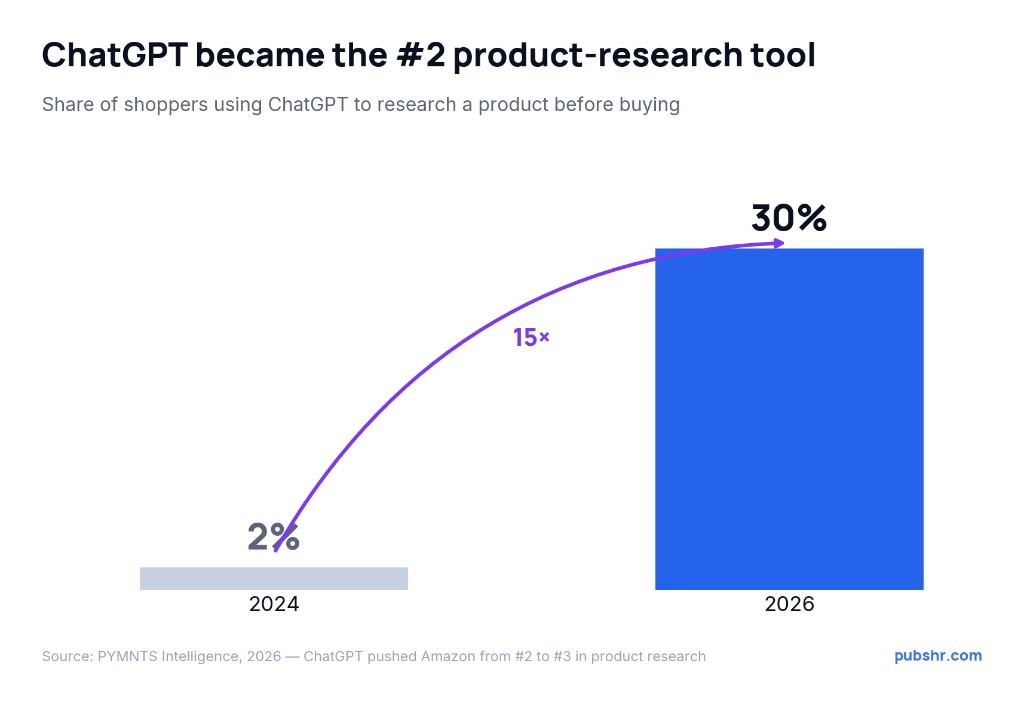
The telling number isn't platform size — it's where in the journey AI now enters. Per PYMNTS Intelligence, the share of shoppers using ChatGPT to research products climbed from 2% to 30% in two years, overtaking Amazon and trailing only Google in that role. Similarweb's 2026 Generative AI Brand Visibility Index puts it another way: 35% of US consumers now use AI at the product-discovery stage, against 13.6% who start with traditional search.
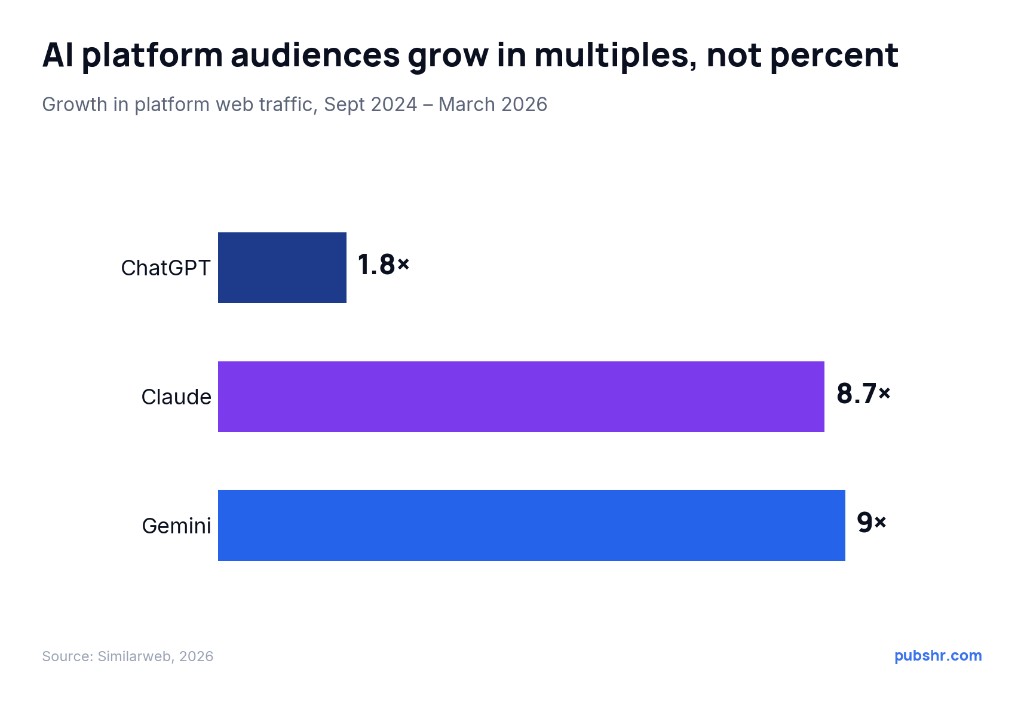
The market shape is changing too. What began as a one-platform story is now a genuine field. Per Similarweb, between September 2024 and March 2026, ChatGPT's web traffic roughly doubled, Claude grew almost ninefold, and Gemini grew ninefold. Optimizing "for one model" no longer holds — visibility has to be maintained across several at once.
Traffic quality
The new traffic turned out to be worth more than the old
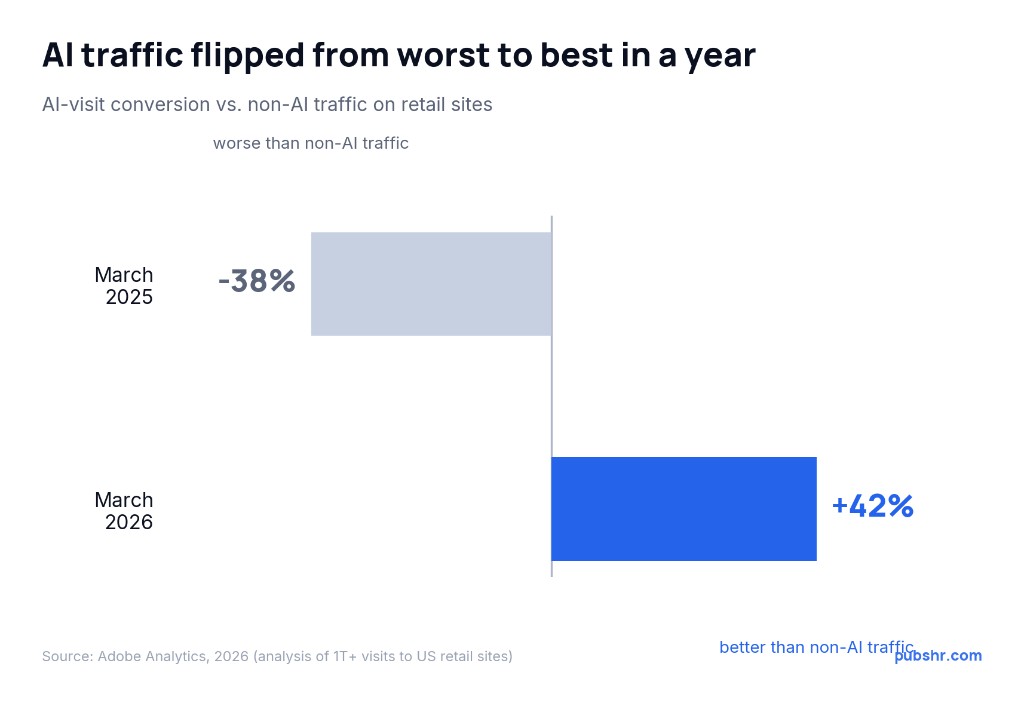
Here a skeptic objects: AI traffic is still small in absolute terms. True — and this is exactly the case where the absolute number misleads. What matters is what happened to quality. Per Adobe Analytics (over 1 trillion visits to US retail sites analyzed), AI traffic converted 38% worse than non-AI traffic in March 2025 — and 42% better by March 2026. In one year, the channel flipped from laggard to leader.
Shopify named the mechanism behind that flip: "journey compression." Discovery and consideration now happen inside the AI, and the user lands on your site already decided. More than half of AI-referred sessions on Shopify begin on a product page — versus roughly 20% for organic search. That visitor converts nearly 50% better and spends about 14% more per order. They don't arrive to browse; they arrive to confirm a choice the AI already made for them.
A click from an AI answer isn't curiosity — it's action from a buyer already deep in the decision. Search sends you spectators; AI sends you people ready to buy.
Based on Shopify, Adobe Analytics and Seer Interactive, 2025–2026
Definition
What GEO is — and why it isn't "SEO 2.0"
Generative Engine Optimization (GEO) is the practice of getting AI engines — ChatGPT, Google AI Overviews, Perplexity, Gemini, Claude — to cite and recommend your brand when a user asks them a question. The term was coined by Princeton researchers back in 2023. The core difference from SEO is the unit of success. SEO competes for a position in a list of links; GEO competes to be named inside the finished answer. SEO wants you found; GEO makes sure you're mentioned.
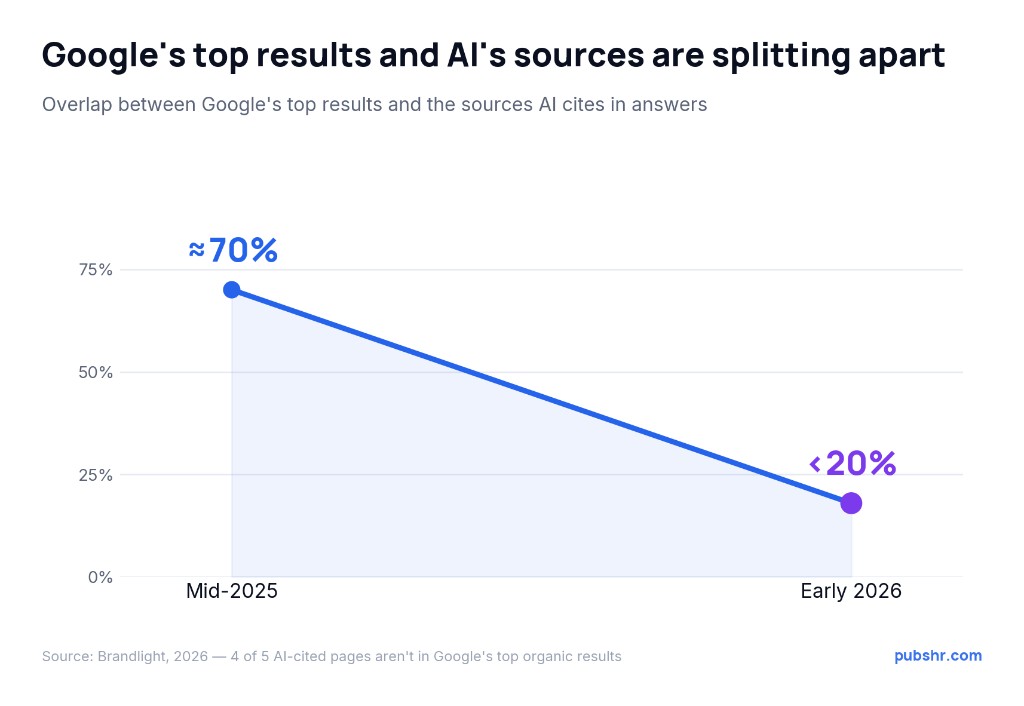
The temptation to treat GEO as an extension of SEO is strong — but the data shows the two systems diverging. Research from Brandlight found the overlap between Google's top results and the sources AI cites has collapsed from about 70% to under 20%. Put plainly: four out of five AI-cited pages aren't in Google's top organic results. Ahrefs adds that fewer than 10% of the sources ChatGPT, Gemini and Copilot cite rank in Google's top 10 for the same query.
The practical takeaway: a strong Google position no longer guarantees presence in AI answers, and presence in AI answers doesn't require a Google top spot. That said, SEO isn't dead — per Similarweb, ~99% of AI Overview citations still come from Google's organic top 10, and Google's AI Mode draws sources only from its own index. The right frame isn't "GEO instead of SEO" but "GEO on top of SEO" — two disciplines you now run in parallel.
The blind spot
The invisibility problem and the measurement gap
Most brands with solid SEO are simply invisible in AI search today — not "ranking poorly," but absent. A vivid example from Similarweb's practice: a travel brand tracked 180 relevant prompts across topics it should have owned outright — luxury hotels, business travel, loyalty programs. It appeared in AI answers just 13 times: a Share of Model of 7.2%. On the rest, it didn't exist for the AI — no mention, no citation, no consideration.
The problem compounds because the channel is hard to measure with standard tools. A large share of AI referrals gets lost in analytics, misfiled as "direct" traffic: paid ChatGPT accounts and Gemini's Deep Research mode often don't pass a referrer. Meanwhile, per Conductor, only about 14% of marketers track AI-search performance at all. The window is open precisely because almost no one is looking yet.
of marketers measure AI-search visibility. The rest can't see their own mentions — or the competitors displacing them.
The playbook
How businesses actually solve GEO
The work splits into two beats: first measure where you stand, then improve and hold the position. Below is a working loop built from what the data supports, not intuition.
Audit your visibility
Run 10–20 prompts in your buyer's language through ChatGPT, Perplexity, Gemini and AI Overviews. Log who gets cited and on which topics. That gives you baseline metrics: Share of Model, brand mention frequency (AICF), and share of voice in answers.
Make your content extractable for AI
Princeton's most validated tactic: content with verifiable statistics and explicit source citations earns 30–40% more visibility in AI answers. Add to that — lead with the answer in the first 60 words of each section, keep paragraphs short, and add schema (Article, FAQPage, Author) in JSON-LD.
Open the door to the right crawlers
The technical minimum many skip: allow OAI-SearchBot and PerplexityBot in robots.txt. A blocked search bot means zero presence in ChatGPT recommendations — no matter how good the content is.
Work through third parties
Per Muck Rack, roughly 82% of AI citations come from earned media, not your own site. AI leans on Wikipedia, Reddit, industry publications and reviews. A brand's presence across those trusted sources directly moves its share of voice.
Put visibility under monitoring
AI citations are volatile: per Erlin, high-traffic prompts churn 23% month over month, and recovering a lost citation takes 45 days on average — with a competitor taking the slot 80% of the time. GEO is brand management now, not a one-off optimization.
What that looks like against concrete business jobs:
A product feed built for the AI assistant
AI assistants skip a product card if they can't instantly parse price, availability and reviews. Structured data and complete feed attributes (GTIN, brand, availability) make a product eligible to be recommended.
Make the shortlist before the first touch
Vendor decisions start with "what alternatives to X should I consider." If the AI doesn't name you there, you're not even evaluated. 6sense: in 95% of deals, the winner was already on the buyer's shortlist.
From 7.2% Share of Model, upward
A brand that owns a topic on paper but is invisible in AI starts with an honest read of its share of answers, then systematically closes the prompt clusters where it isn't mentioned at all.
Control what AI "thinks" of the brand
AI can cite stale or wrong facts about a company. Without monitoring, errors compound for months; with it, they're caught and corrected in a couple of weeks.
The bottom line
The first-mover window is still open — but closing
Here's the 2026 lineup: most enterprise teams have already launched GEO initiatives, while small and mid-market businesses mostly haven't started (Digital Agency Network). That gap is the opportunity — and it's temporary. The forecasts are blunt: up to 25% of traditional search queries are at risk of disappearing by the end of 2026, and Gartner projects organic traffic to websites will decline more than 50% by 2028 as generative search scales.
GEO isn't a tactical tweak or "one more channel." It's the shift from "how do they find us" to "will they name us" — when the AI is choosing on the user's behalf. Brands that build measurement and AI-visibility work into their process now gain a compounding data advantage rivals can't buy or quickly copy. The search bar still exists. But increasingly, the answer is already somewhere else.
Manage your brand's presence in generative search
GEO Audit measures your visibility in AI answers; GEO Boost improves and defends it.
Run GEO Auditpubshr.com
Data sources: Stanford HAI AI Index 2026 · Similarweb Generative AI Brand Visibility Index 2026 · Adobe Analytics 2026 · Shopify · PYMNTS Intelligence · Princeton (Aggarwal et al., KDD 2024) · Brandlight · Ahrefs · Muck Rack · Conductor · Erlin.